The story
Who's who among the paladins
A cast list for the Syracuse pupi: Charlemagne, Orlando, Rinaldo, Angelica, Bradamante, Ruggiero, the Saracen kings and Gano, and how to spot each one.
Find a puppet show date ↗Quick answer
The pupi tell the Carolingian cycle: Charlemagne and his paladins against Saracen invaders, as Italian Renaissance poets retold it. The heroes you are most likely to meet are Orlando, the champion; his cousin Rinaldo; Angelica, the princess they both love; Bradamante, the woman knight in white; and Ruggiero, the Saracen she loves. The villain is Gano the traitor. Christian knights wear family emblems; Saracens wear turbans and half moons.
Where the stories come from
The Matter of France, also called the Carolingian cycle, is the body of medieval legend about Charlemagne and his paladins, which grew out of the Old French chansons de geste. The paladins, or Twelve Peers, were the foremost knights of his court, and their names vary from source to source, though Roland always leads them. Italian poets later reworked the cycle with more fantasy and more romance: Boiardo's Orlando innamorato and Ariosto's Orlando furioso. The Sicilian puppet theatres drew on those poems, through a prose retelling published in instalments from 1858.
Charlemagne and Orlando
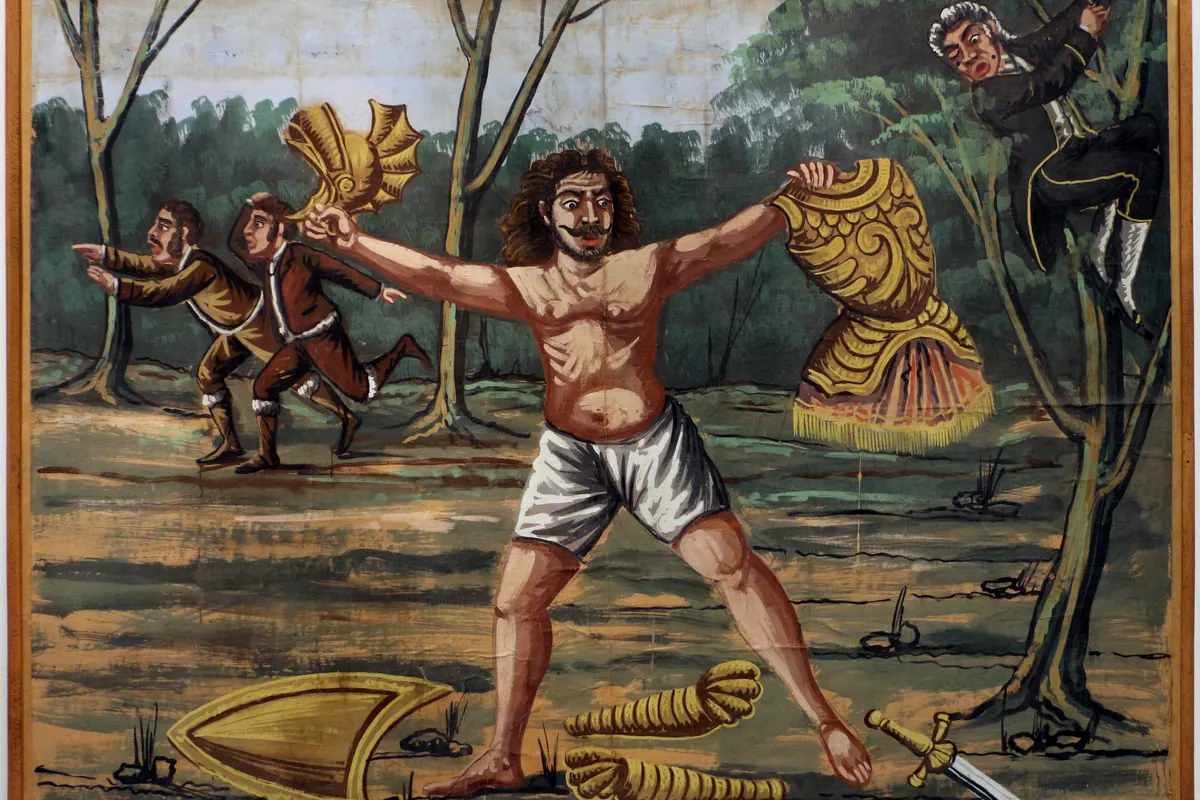
Charlemagne is the crowned emperor the Christian knights serve; the real one was crowned emperor in Rome in 800. His great champion is Orlando, the Italian Roland. The historical Roland died at Roncevaux Pass in 778, and the Song of Roland tells of his heroic death there. Legend arms him with the sword Durendal and the oliphant, a horn. In Ariosto's poem his love for Angelica tips him into madness, the scene on the painted pupi poster shown here.
Rinaldo and Bradamante
Rinaldo, the Italian Renaud de Montauban, began as one of the Four Sons of Aymon, brothers who fought a long war against Charlemagne after Renaud killed one of the emperor's nephews. He rides Bayard, an enchanted horse, and in the Italian poems he is Orlando's cousin and his rival for Angelica. His sister Bradamante is a knight in her own right: dressed in white, with a white shield and a magic lance that unhorses anyone it touches. In Orlando furioso it is she who frees Ruggiero from the wizard's prison.
Angelica, Ruggiero and the lovers' knot
Angelica arrives at Charlemagne's court as a princess of Cathay and sets every knight competing for her. She slips away from them, is rescued from a sea monster by the Saracen knight Ruggiero, and in the end marries Medoro, an ordinary soldier, which is the news that drives Orlando mad. Ruggiero, raised in Africa by the wizard Atlante, fights for the Saracens until he falls in love with Bradamante, converts and marries her. Their story runs through Orlando furioso from start to finish.
The Saracen side
The Saracens are the paladins' enemies, and the poems give them splendid kings. Agramante, King of Africa, leads the invasion of France. Rodomonte, King of Sarza and Algiers, besieges Charlemagne in Paris and boasts so much that his name became the word rodomontade; he dies in a duel with Ruggiero at the wedding. Ferraù, a Saracen knight, is another regular of the cycle. On the pupi stage, Saracens have sharper features, wear trousers and turbans, and carry half moons and stars on their armour.
Astolfo and the trip to the Moon
Astolfo, the English paladin and cousin to Orlando and Rinaldo, is the cycle's comic hero. He owns a golden lance that unhorses opponents, a magic horn whose blast sends enemies running, and a book of spells with an alphabetical index. When Orlando loses his wits, Astolfo sets off on the hippogriff, the flying horse, to find a cure, then rides a flaming chariot to the Moon, where everything lost on Earth ends up, and brings Orlando's wits back in a bottle. Episodes like this are why the cycle never ran short of material.
Gano, the traitor
Every cycle needs a villain, and this one has Gano di Maganza, the Italian Ganelon. In the Song of Roland he resents his stepson Roland and betrays Charlemagne's army to the Saracens, which leads to the ambush at Roncevaux. The treachery of the house of Maganza became a byword in Italy. Whenever Gano appears in the story, treachery is rarely far behind, and knowing that alone tells you a great deal about a scene.
How to tell them apart on stage
Christian knights are carved with gentle, symmetrical faces, wear a short skirt over their armour, and carry their family emblems on helmet, breastplate and shield so that the audience can recognise them. Saracens have more marked features. Characters without armour, such as ladies, servants and comic figures, are a separate group. Watch the shields: once you have picked out Orlando's or Rinaldo's emblem, you can follow them through any battle.
Read next: Puppets in Italian: worth it?
Sources